policy / chips / models / capital · both fronts, auto-wired
25 sources / 144 items / updated 2026-10-28 17:58
Chips on both sides: leaders' prices, turnover and market cap · build-time snapshot, not live; tap a headline for the full story
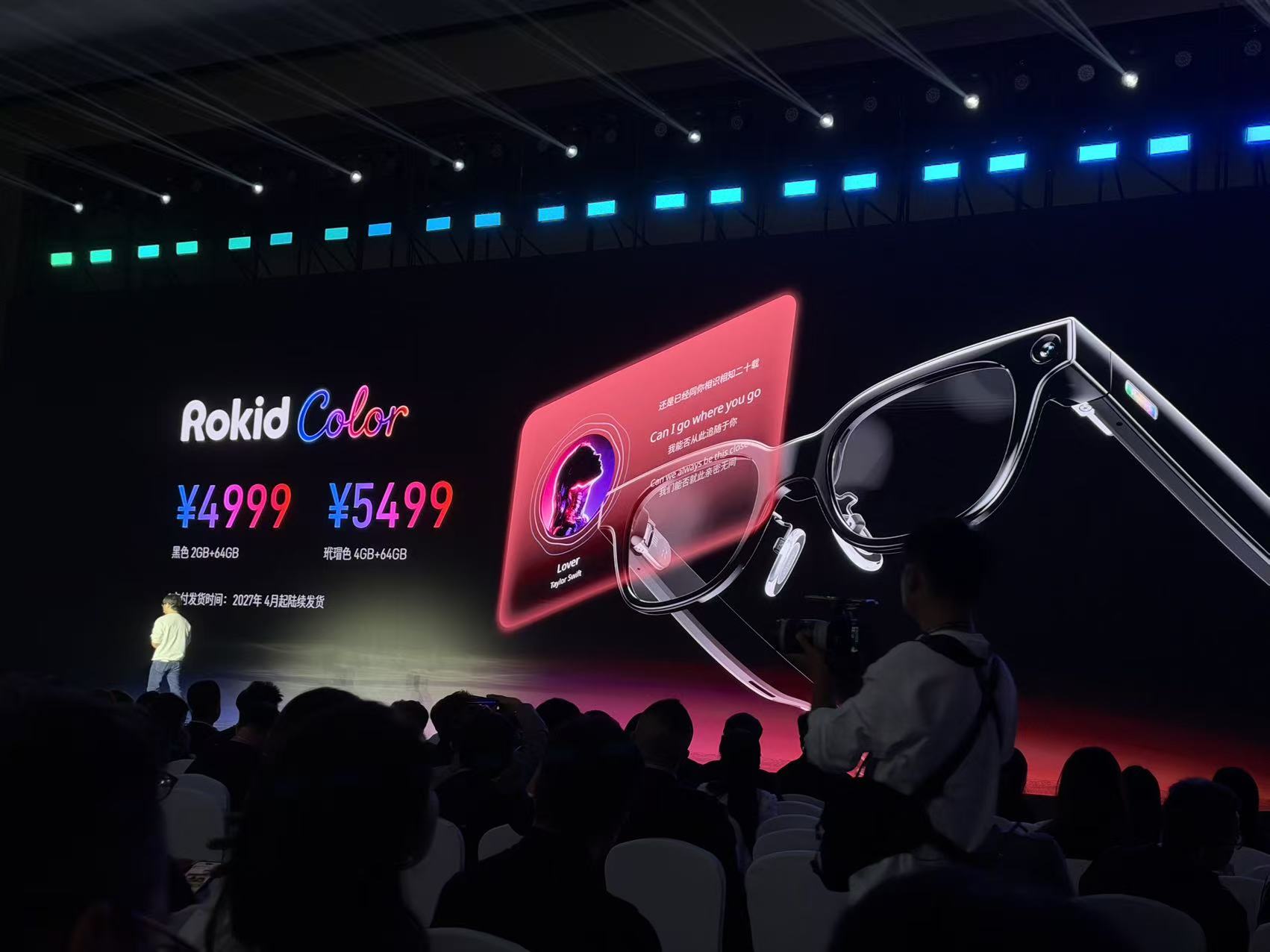
At the Rokid Jungle 2026 launch event held in Hangzhou on October 27, Rokid unveiled three new products — the Rokid Glasses 2, Rokid Color, and Rokid Ring — targeting everyday wear, full-color display, and human-machine interaction respectively. The Rokid Color starts at 4,999 yuan (5,499 yuan for the tortoiseshell version); the Rokid Glasses 2 is priced at 3,699 yuan (3,849 yuan tortoiseshell); and the Rokid Ring costs 1,699 yuan, with a 998-yuan presale price open to owners of the first- or second-generation Rokid AI glasses. "This moment, Rokid waited 12 years — and I waited 15," said founder and CEO Misa Zhu.
On October 28, Ant Group's Ling large model team officially released Ling-3.1-flash-1019 as open source.
From October 19 to 24, the Beijing Academy of Artificial Intelligence (BAAI) visited The High School Affiliated to Renmin University of China (RDFZ), supporting a Haidian district deployment meeting for Beijing's "learning by doing" pilot program and seminars on AI-empowered talent cultivation, and exploring applications of SoulAgent in real classroom, teaching-research, and learning scenarios. SoulAgent is BAAI's "personal agent that knows you better the more you use it." In education, it explores areas such as "attending classes on your behalf," teacher AI avatars, essay grading, and teaching Q&A — helping teachers improve efficiency and build up teaching materials, while supporting students with feedback, follow-up questions, and continued thinking. The "attend class for me" feature can listen to multiple classes at once, so classroom content keeps serving teaching research.
On October 26, Amap and Alibaba's Token Hub business unit jointly released λ0, an embodied AI model trained on videos and motion data of everyday human activity to teach humanoid robots whole-body tasks like walking, carrying and two-handed manipulation. The team built the HumanVerse dataset, 500 hours of human activity captured in open environments — first-person video recorded via wearables, with body motion data, reconstructed hand movements, viewpoint matching and motion alignment converted into humanoid-compatible training data. Training runs in three stages: learning object interaction and hand movements from diverse first-person video, coordinating body and hands on HumanVerse, then adapting to robot tasks. Applied to Unitree's G1 humanoid, λ0 reached a 90.0% success rate on the SIMPLE benchmark and completed 40 runs across four real-world mobile manipulation tasks.
On October 27, Chongqing-based chip designer WuQi Microelectronics officially launched the WQ9002, an ultra-low-power dual-band Wi-Fi 6 chip aimed at battery-powered devices such as AI glasses, smart wearables and low-power IP cameras. The chip's Wi-Fi keep-alive current drops as low as 30μA under DTIM10, letting devices hold a network connection at very low power with fast wake-up. WuQi says that by optimizing the underlying architecture and communication link, per-bit current consumption can fall below Bluetooth, offering a new option for AI glasses and other devices that need high-bandwidth wireless connectivity alongside long battery life.
You book a flight and hotel, then keep checking prices every few days to see whether rebooking beats the change fees; you start a streaming subscription for one show, forget to cancel, and find months of auto-renewal charges on the bill. On October 27, Ant Group released LingGuang 2.0, a 'personal AI assistant that manages your affairs' and one of the first Personal Agent products from a major Chinese tech company, aiming to take over exactly this kind of recurring busywork: instead of passively handling one-off commands, it proactively spots needs and keeps managing them. After Muse accelerated the global Personal Agent race and Chinese giants began dense deployments, LingGuang is first to ship a product answer, starting with fare-watching and bill-sorting — moving AI from one-time help to long-term management.
The endgame for the top players in smart vehicles won't stop at smart vehicles.
At Rokid's AI glasses launch event on October 27, Rokid and Qwen Office announced a partnership that brings Qwen Office to Rokid AI glasses. After adding 'Qwen Office' from the agent store in the Rokid AI app and binding their account, users can summon it by voice from the glasses, assign tasks and view results on-device — for example, saying 'Qwen Office, research the current state of the AI glasses industry' gets a delivered report readable on the glasses, with status notifications pushed in real time so users don't have to keep checking progress. Users can also ask questions about what's in front of them, such as 'What are the risks in the plan on this table?' during a meeting, and get analysis grounded in the glasses' camera view. Rokid supplies the hardware, system adaptation, account access and glasses-side entry point, while Qwen Office provides the agent runtime for understanding voice, images and task intent.
The online preliminary round of the first Ant Lingbo Embodied AI Model Challenge, hosted by Ant Lingbo Technology, closed on October 27 with record participation: 1,855 teams and 3,252 contestants from 13 countries, spanning 648 well-known universities, research institutes and leading tech companies including 41 overseas institutions — the largest inaugural contest in the field. Launched in September at the 2026 Bund Summit with ModelScope and Alibaba Cloud's Tianchi, and built on the open-source LingBot-VLA2.0 model, the challenge focuses on model training and tuning, simulation-based generalization evaluation and real-robot adaptation, open to global companies, universities, individual developers and enthusiasts. The offline finals, a 48-hour real-robot hackathon, take place November 14–16 in Shanghai's Zhangjiang.
The era of OCR 3.0 has arrived.
Specialized models, after all, are still the right ones for specialized jobs.
A way to break the deadlock stalling green-power direct-connection projects.
Zhipu AI's internal GLM-Omni has surfaced in a new paper from Tsinghua University and Zhipu AI, with Tang Jie as corresponding author — and the moment the model name appeared, social media linked it to GLM-5.5. The paper reveals no version mapping, but details GLM-Omni's technical foundation and its experimental results in unified visual understanding and image generation, reporting 54% image-generation accuracy against just 14.57% for text Q&A. One result stands out: after image-generation training, GLM-Omni correctly drew a specified number on a jersey 72% of the time in digit tasks, yet answered the same jersey-number question in text with only 2% accuracy — knowledge the model can reproduce in images barely survives as answers, exposing a key bottleneck for unified multimodal models. (Paper: arxiv.org/pdf/2610.21459)
On October 27, Baidu released and open-sourced ERNIE Unlimited OCR 2, claiming a world first in parsing documents of arbitrary page count — lifting OCR's processing ceiling from dozens of pages to effectively unlimited while reaching state-of-the-art performance. In tests, the model parsed all seven Harry Potter books, more than 3,600 pages in total, in a single pass, maintaining high accuracy and efficiency even as document length grows dramatically. On the public benchmarks MPDocBench, which targets multi-page document parsing, and MarathonDocBench, which evaluates hundred-page ultra-long documents, ERNIE Unlimited OCR 2 scored 84.6 and 77.1 respectively for end-to-end SOTA results, well ahead of Qwen 3.8-Max, Gemini-3.8-Flash, GLM-5.3-Flash and DeepSeek-4.1-Flash.
On October 26, the Beijing Academy of Artificial Intelligence (BAAI) held the first roadshow of its Yuanchuang Program at the Zhongguancun International Technology Transfer Center, putting five AI hard-tech ventures on stage: Linjiehe Technology, Lingshu Qizhi, Zhangliangchang Technology, Cangqiong Jizhi and Qianxiangliang Technology. Their projects span 3D self-selecting V-RRAM chips, neuromorphic embodied intelligence, Hamiltonian world models, reliable physical intelligence for extreme environments, and a unified world model of the surface physical environment. The event also included sessions pairing founding teams with investment funds. Positioned by BAAI deputy director Yang Yang as an incubation track mainly for BAAI scholars working on original AI research, the program aims to help lab-stage results cross the gap between engineering validation and commercialization.
On October 23, autonomous-driving company Jiushi signed a strategic investment agreement with Xinhua News Agency Investment Holding (Xinhua Investment Holding), the firm's first direct industrial investment in autonomous driving and physical AI. The two sides will combine strengths on brand building, smart logistics ecosystem development and overseas expansion. Jiushi has leapt ahead this year: it became the industry's first unicorn valued at over 10 billion yuan, achieved the world's first scaled mass production of an L4 mapless solution, and expects annualized revenue from its AI Driver service — excluding vehicle sales — to top $100 million by year-end. Its business now covers more than 300 cities in over 20 countries, and it was recognized as a national-level specialized 'little giant.' Xinhua Investment Holding said it is 'not investing in a vehicle, but in a road — a Chinese road for smart logistics.'
End of archive
On October 27 local time, NVIDIA and Meta announced an expanded partnership around the Muse and Muse-family AI models, focusing on boosting model inference and training performance and improving the operating efficiency of AI agents. NVIDIA also plans to invest $3 billion in Meta's equity issuance program to deepen the strategic AI collaboration. Meta's Muse-family models and AI agents already run on NVIDIA computing infrastructure, with frontier-level benchmark results and growing consumer downloads since launch; the partnership will optimize training, inference, and workflows to raise overall performance and lower total cost of ownership (TCO). On agent safety, the two will explore further cooperation based on the NVIDIA OpenShell reference architecture, including using NVIDIA OpenShell for secure agent deployment and NVIDIA Sentry for monitoring agent behavior. Meta plans to scale up its NVIDIA computing platform deployments.
Researchers from KAIST and Google DeepMind have jointly proposed FL4N, a 4D novel view synthesis model that reconstructs dynamic scenes from monocular video and renders views from different camera angles and time points in real time. The paper is available on arXiv, with code and model weights open-sourced. Unlike traditional 3D reconstruction, which targets static scenes, 4D reconstruction must capture how objects move over time — and existing approaches built on explicit representations such as 4D Gaussians often suffer ghosting, edge artifacts, and poor temporal consistency in complex motion. FL4N instead uses feed-forward latent space modeling, encoding a scene's spatial structure and temporal changes into a unified latent representation. Built on a pretrained static scene model, it adds a lightweight dynamic encoder that learns motion through temporal residuals, reducing reliance on complex 3D motion annotations, uses static scene features to separate object motion from camera-induced parallax, and supports independently adjusting viewpoint and scene time.
Valve has released a new update for Half-Life: Alyx that brings foveated rendering to the PC VR version. The feature can be enabled manually in the game's advanced performance settings, reducing GPU load and improving performance. It supports NVIDIA GTX 16 series, RTX 20 series, and newer GPUs, while AMD users need to run the game in Vulkan mode. According to Valve's setup guide, eye tracking works on headsets including Steam Frame, Meta Quest Pro, Bigscreen Beyond 2e, Apple Vision Pro, PS VR2, and Pimax via the appropriate drivers or third-party tools. The update also adds stencil buffer markers for the Steam Frame native version to improve reprojection quality, and fixes rendering crashes caused by some Workshop content as well as the "Gnome Alone" achievement failing to unlock.
AI's next goal is simulating reality.
Meta has launched a stock issuance plan worth roughly $35 billion, and beyond this offering it plans to start another share sale of up to $60 billion as early as Q1 2027. If both are fully subscribed, the combined raise would total $95 billion, all earmarked for AI business expansion. The plans come as Meta keeps pouring money into data centers, computing infrastructure, and AI product development to compete with OpenAI and Anthropic. Notably, chipmakers NVIDIA, AMD, and Broadcom have expressed interest in subscribing to a combined total of up to $5 billion of Meta stock, though none has made a formal commitment yet.
Vision Express Philippines has teased on social media that Ray-Ban Meta AI glasses will soon arrive at its offline stores, marking the series' official debut in the Philippine market. The retailer has not yet disclosed a launch date, local pricing, or the list of stores that will sell the glasses and offer try-ons. The Facebook post reads: 'First in the Philippines. Ray-Ban AI glasses are coming to Vision Express — come be among the first to experience them.' The company's Philippine website currently has no product page, AI glasses section or waitlist; all teaser details appear only in the social post. (Source: gadgetpilipinas)
Last year, Vibe Coding went viral: with tools like Cursor, Claude Code and Lovable, people with zero programming background could 'hand-build' working apps just by telling AI what they wanted. That DIY wave is now spilling from screens into physical hardware. As AI coding tools like Codex and Claude Code evolved to take on compiling, testing and debugging, developers pairing them with ESP32 boards, sensors, open-source projects and 3D printing have built talking AI toys, smart terminals that connect and remotely control home devices, and even ordinary glasses retrofitted with a camera and AI into simple smart glasses. Ideas that once lived in people's heads are becoming physical objects, and an AI-fueled hardware DIY craze is heating up.
On October 26, Anthropic publicly filed its S-1 prospectus with the SEC to list on the Nasdaq Global Select Market under the ticker ANT, with press coverage discussing a valuation range of $1.5 trillion to $2 trillion while the pricing range has yet to be disclosed. Within 24 hours the 300-plus-page filing was picked apart across tech and finance circles: H1 2026 revenue came in at $16.286 billion, up from $1.163 billion a year earlier; Q2 delivered $974 million in operating profit, the first in company history; and the $80.7 billion net loss is mostly $72.388 billion in non-cash fair-value changes on convertible bonds, derivative liabilities, and SAFE instruments. Beyond the Wall Street narrative, the article notes the disconnect felt by mainland Chinese users, who see Claude as arguably the most ban-prone and strictly risk-controlled AI service on the market.
AI-driven transaction orders on Shopify have grown 13-fold. Pre-orders for Apple's first foldable, the iPhone Duo, opened the morning of October 16 starting at $1,999; with first-batch supply tight, delivery dates soon slipped to January of next year — and this time it wasn't just people refreshing screens: a MacRumors forum user complained about missing out, while a Reddit user showed off their Muse bot grabbing several units at once before any human could click. Muse, the personal agent Meta launched on September 8, at one point topped the US App Store free chart with downloads quickly passing 2.5 million; Meta says shopping has become one of its main use cases, and it shipped a new version timed to the iPhone Duo launch to support the new device.
On the same day, OpenAI also dropped three new AI science discoveries.
OpenAI is once again pushing hard on price-performance in large models, launching GPT-6.1 Terra as a budget workhorse for the agent era.
AI has started turning in its answers one after another — and humans may not even be able to grade them in time.
The world's richest sibling duo make a grand entrance, while the seven co-founders still hold a tight grip on 50.1% of total voting power.
Taiwan optical suppliers are accelerating their AI-glasses push, the Commercial Times reported: Genius Electronic Optical, Asia Optical, Kinko Optical and Canon are expanding into optical lenses, waveguides, light engines and smart-glasses manufacturing as Meta, Google and others build out the market. Citing IDC, the report forecasts global AI glasses sales of 13.04 million units in 2026, rising to 16.18 million in 2027. As smart glasses add photography, AI interaction and near-eye display, lenses, micro-projection optics and waveguides grow more critical. Genius Electronic Optical has been building AI glasses, AR and VR optics, is working with a US customer and in talks with mainland Chinese brands; despite slower VR lens demand, AI glasses and AR products continue to pull orders. Its revenue for the first three quarters of 2026 totaled NT$19.636 billion, up 10.1% year over year, with new-product sampling and certification on track.
New Mexico State University's Global Campus has received funding from Meta's Los Lunas data center to launch 'VR for Educators,' a professional training course helping K-12 teachers bring immersive technology into everyday teaching. The self-paced online program covers VR fundamentals, instructional design, classroom implementation and real-world use cases, aiming to boost student engagement and learning experiences. Courses open in fall 2026, first to teachers in communities around the Meta data center, then expanding to more US school districts via the NMSU Global Campus micro-credential platform. NMSU notes VR can offer experiences traditional classrooms cannot — such as exploring the solar system in immersive 3D to deepen science understanding — while Meta says the partnership aims to equip students with the skills needed for the future digital economy through teacher training.
Is the model starting to make use of GPU caches for its chats?
End of archive